Perovskite light-intensity dependant JV fits with SIMsalabim (fake data)
This notebook is a demonstration of how to fit light-intensity dependent JV curves with drift-diffusion models using the SIMsalabim package.
[1]:
# Import necessary libraries
import warnings, os, sys, shutil
# remove warnings from the output
os.environ["PYTHONWARNINGS"] = "ignore"
warnings.filterwarnings(action='ignore', category=FutureWarning)
warnings.filterwarnings(action='ignore', category=UserWarning)
import pandas as pd
import matplotlib.pyplot as plt
import numpy as np
from numpy.random import default_rng
import torch, copy, uuid
import pySIMsalabim as sim
from pySIMsalabim.experiments.JV_steady_state import *
import ax, logging
from ax.utils.notebook.plotting import init_notebook_plotting, render
init_notebook_plotting() # for Jupyter notebooks

try:
    from optimpv import *
    from optimpv.optimizers.axBOtorch.axUtils import *
except Exception as e:
    sys.path.append('../') # add the path to the optimpv module
    from optimpv import *
    from optimpv.optimizers.axBOtorch.axUtils import *
[INFO 01-20 10:53:13] ax.utils.notebook.plotting: Injecting Plotly library into cell. Do not overwrite or delete cell.
[INFO 01-20 10:53:13] ax.utils.notebook.plotting: Please see
    (https://ax.dev/tutorials/visualizations.html#Fix-for-plots-that-are-not-rendering)
    if visualizations are not rendering.
Define the parameters for the simulation
[2]:
params = [] # list of parameters to be optimized

mun = FitParam(name = 'l2.mu_n', value = 6e-4, bounds = [1e-5,1e-3], values = None, start_value = None, log_scale = True, value_type = 'float', fscale = None, rescale = False, stepsize = None, display_name=r'$\mu_n$', unit='m$^2$ V$^{-1}$s$^{-1}$', axis_type = 'log', std = 0,encoding = None,force_log = True)
params.append(mun)

mup = FitParam(name = 'l2.mu_p', value = 4e-4, bounds = [1e-5,1e-3], values = None, start_value = None, log_scale = True, value_type = 'float', fscale = None, rescale = False, stepsize = None, display_name=r'$\mu_p$', unit=r'm$^2$ V$^{-1}$s$^{-1}$', axis_type = 'log', std = 0,encoding = None,force_log = True)
params.append(mup)

bulk_tr = FitParam(name = 'l2.N_t_bulk', value = 1e20, bounds = [1e19,1e21], values = None, start_value = None, log_scale = True, value_type = 'float', fscale = None, rescale = False, stepsize = None, display_name=r'$N_{T}$', unit=r'm$^{-3}$', axis_type = 'log', std = 0,encoding = None,force_log = False)
params.append(bulk_tr)

HTL_int_trap = FitParam(name = 'l1.N_t_int', value = 5e11, bounds = [1e11,1e13], values = None, start_value = None, log_scale = True, value_type = 'float', fscale = None, rescale = False, stepsize = None, display_name=r'$N_{T,int}^{HTL}$', unit='m$^{-2}$', axis_type = 'log', std = 0,encoding = None,force_log = False)
params.append(HTL_int_trap)

ETL_int_trap = FitParam(name = 'l2.N_t_int', value = 4e12, bounds = [1e11,1e13], values = None, start_value = None, log_scale = True, value_type = 'float', fscale = None, rescale = False, stepsize = None, display_name=r'$N_{T,int}^{ETL}$', unit='m$^{-2}$', axis_type = 'log', std = 0,encoding = None,force_log = False)
params.append(ETL_int_trap)

Nions = FitParam(name = 'l2.N_ions', value = 1e22, bounds = [1e20,5e22], type='range', values = None, start_value = None, log_scale = True, value_type = 'float', fscale = None, rescale = False, stepsize = None, display_name=r'$C_{ions}$', unit='m$^{-3}$', axis_type = 'log', std = 0,encoding = None,force_log = False)
params.append(Nions)

R_series = FitParam(name = 'R_series', value = 1e-4, bounds = [1e-5,1e-3], type='range', values = None, start_value = None, log_scale = True, value_type = 'float', fscale = None, rescale = False, stepsize = None, display_name=r'$R_{series}$', unit=r'$\Omega$ m$^2$', axis_type = 'log', std = 0,encoding = None,force_log = False)
params.append(R_series)

# save the original parameters for later
params_orig = copy.deepcopy(params)
num_free_params = len([p for p in params if p.type != 'fixed'])
Generate some fake data
Here we generate some fake data to fit. The data is generated using the same model as the one used for the fitting, so it is a good test of the fitting procedure. For more information on how to run SIMsalabim from python see the pySIMsalabim package.
[3]:
# Set the session path for the simulation and the input files
session_path = os.path.join(os.path.join(os.path.abspath('../'),'SIMsalabim','SimSS'))
input_path = os.path.join(os.path.join(os.path.join(os.path.abspath('../'),'Data','simsalabim_test_inputs','fakePerovskite')))
simulation_setup_filename = 'simulation_setup_fakePerovskite.txt'
simulation_setup = os.path.join(session_path, simulation_setup_filename)
optical_files = ['nk_glass.txt','nk_ITO.txt','nk_PTAA.txt','nk_FACsPbIBr.txt','nk_C60_1.txt','nk_Au.txt']
# path to the layer files defined in the simulation_setup file
l1 = 'PTAA.txt'
l2 = 'fakePerovskite.txt'
l3 = 'C60.txt'
l1 = os.path.join(input_path, l1)
l2 = os.path.join(input_path, l2)
l3 = os.path.join(input_path, l3)

# copy this files to session_path
force_copy = True
if not os.path.exists(session_path):
    os.makedirs(session_path)
for file in [l1,l2,l3,simulation_setup_filename]:
    file = os.path.join(input_path, os.path.basename(file))
    if force_copy or not os.path.exists(os.path.join(session_path, os.path.basename(file))):
        shutil.copyfile(file, os.path.join(session_path, os.path.basename(file)))
    else:
        print('File already exists: ',file)
# copy the optical files to the session path
for file in optical_files:
    file = os.path.join(input_path, os.path.basename(file))
    if force_copy or not os.path.exists(os.path.join(session_path, os.path.basename(file))):
        shutil.copyfile(file, os.path.join(session_path, os.path.basename(file)))

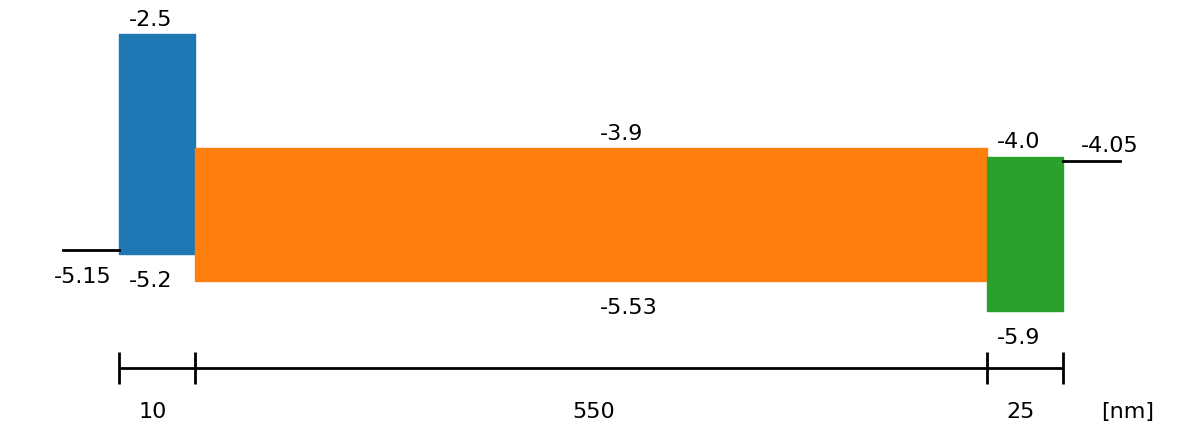
# Show the device structure
fig = sim.plot_band_diagram(simulation_setup, session_path)

# reset simss
# Set the JV parameters
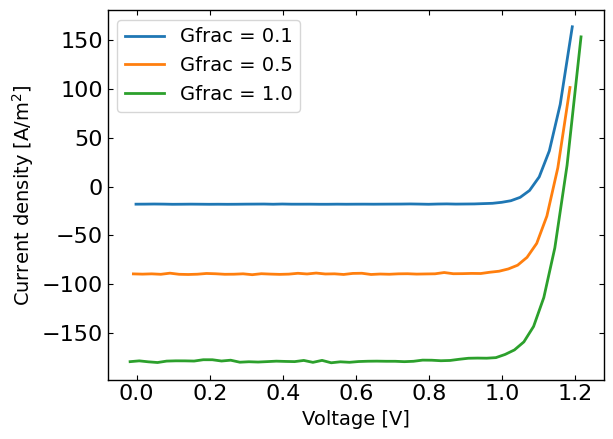
Gfracs = [0.1,0.5,1.0] # Fractions of the generation rate to simulate (None if you want only one light intensity as define in the simulation_setup file)
UUID = str(uuid.uuid4()) # random UUID to avoid overwriting files

cmd_pars = [] # see pySIMsalabim documentation for the command line parameters
# Add the parameters to the command line arguments
for param in params:
    if param.name == 'l2.N_ions':
        cmd_pars.append({'par':'l2.N_cation', 'val':str(param.value)})
        cmd_pars.append({'par':'l2.N_anion', 'val':str(param.value)})
    else:
        cmd_pars.append({'par':param.name, 'val':str(param.value)})

# Add the layer files to the command line arguments
cmd_pars.append({'par':'l1', 'val':'PTAA.txt'})
cmd_pars.append({'par':'l2', 'val':'fakePerovskite.txt'})
cmd_pars.append({'par':'l3', 'val':'C60.txt'})

# Run the JV simulation
ret, mess = run_SS_JV(simulation_setup, session_path, JV_file_name = 'JV.dat', G_fracs = Gfracs, parallel = True, max_jobs = 3, UUID=UUID, cmd_pars=cmd_pars)

# save data for fitting
X,y = [],[]
X_orig,y_orig = [],[]
if Gfracs is None:
    data = pd.read_csv(os.path.join(session_path, 'JV_'+UUID+'.dat'), sep=r'\s+') # Load the data
    Vext = np.asarray(data['Vext'].values)
    Jext = np.asarray(data['Jext'].values)
    G = np.ones_like(Vext)
    rng = default_rng()#
    noise = rng.standard_normal(Jext.shape) * 0.01 * Jext
    Jext = Jext + noise
    X = Vext
    y = Jext

    plt.figure()
    plt.plot(X,y)
    plt.show()
else:
    for Gfrac in Gfracs:
        data = pd.read_csv(os.path.join(session_path, 'JV_Gfrac_'+str(Gfrac)+'_'+UUID+'.dat'), sep=r'\s+') # Load the data
        Vext = np.asarray(data['Vext'].values)
        Jext = np.asarray(data['Jext'].values)
        G = np.ones_like(Vext)*Gfrac
        rng = default_rng()#
        noise = rng.standard_normal(Jext.shape) * 0.005 * Jext

        if len(X) == 0:
            X = np.vstack((Vext,G)).T
            y = Jext + noise
            y_orig = Jext
        else:
            X = np.vstack((X,np.vstack((Vext,G)).T))
            y = np.hstack((y,Jext+ noise))
            y_orig = np.hstack((y_orig,Jext))

    # remove all the current where Jext is higher than a given value
    X = X[y<200]
    X_orig = copy.deepcopy(X)
    y_orig = y_orig[y<200]
    y = y[y<200]


    plt.figure()
    for Gfrac in Gfracs:
        plt.plot(X[X[:,1]==Gfrac,0],y[X[:,1]==Gfrac],label='Gfrac = '+str(Gfrac))
    plt.xlabel('Voltage [V]')
    plt.ylabel('Current density [A/m$^2$]')
    plt.legend()
    plt.show()
Run the optimization
[4]:
# Define the Agent and the target metric/loss function
from optimpv.models.DDfits.JVAgent import JVAgent
metric = 'nrmse' # can be 'nrmse', 'mse', 'mae'
loss = 'linear' # can be 'linear', 'huber', 'soft_l1'

jv = JVAgent(params, X, y, session_path, simulation_setup, parallel = True, max_jobs = 3, metric = metric, loss = loss)

# Calulate the target metric for the original parameters
best_fit_possible = loss_function(calc_metric(y,y_orig, metric_name = metric),loss)
print('Best fit: ',best_fit_possible)
Best fit: 0.0015363848442940548
[5]:
from optimpv.optimizers.axBOtorch.axBOtorchOptimizer import axBOtorchOptimizer
from optimpv.optimizers.axBOtorch.axUtils import get_VMLC_default_model_kwargs_list

# Define the optimizer
optimizer = axBOtorchOptimizer(params = params, agents = jv, models = ['SOBOL','BOTORCH_MODULAR'],n_batches = [1,45], batch_size = [10,2], model_kwargs_list = get_VMLC_default_model_kwargs_list(num_free_params))
[6]:
# optimizer.optimize() # run the optimization with ax
optimizer.optimize_turbo() # run the optimization with turbo
[INFO 01-20 10:53:15] optimpv.axBOtorchOptimizer: Starting optimization with 46 batches and a total of 100 trials
[INFO 01-20 10:53:15] optimpv.axBOtorchOptimizer: Starting Sobol batch 1 with 10 trials
[INFO 01-20 10:53:17] optimpv.axBOtorchOptimizer: Finished Sobol with best value of 0.031934
[INFO 01-20 10:53:19] optimpv.axBOtorchOptimizer: Finished Turbo batch 2 with 2 trials with current best value: 3.1934e-02, TR length: 8.00e-01
[INFO 01-20 10:53:20] optimpv.axBOtorchOptimizer: Finished Turbo batch 3 with 2 trials with current best value: 3.1934e-02, TR length: 8.00e-01
[INFO 01-20 10:53:21] optimpv.axBOtorchOptimizer: Finished Turbo batch 4 with 2 trials with current best value: 3.1934e-02, TR length: 5.00e-01
[INFO 01-20 10:53:22] optimpv.axBOtorchOptimizer: Finished Turbo batch 5 with 2 trials with current best value: 2.5532e-02, TR length: 5.00e-01
[INFO 01-20 10:53:23] optimpv.axBOtorchOptimizer: Finished Turbo batch 6 with 2 trials with current best value: 2.5532e-02, TR length: 5.00e-01
[INFO 01-20 10:53:25] optimpv.axBOtorchOptimizer: Finished Turbo batch 7 with 2 trials with current best value: 2.5532e-02, TR length: 5.00e-01
[INFO 01-20 10:53:26] optimpv.axBOtorchOptimizer: Finished Turbo batch 8 with 2 trials with current best value: 2.5532e-02, TR length: 5.00e-01
[INFO 01-20 10:53:27] optimpv.axBOtorchOptimizer: Finished Turbo batch 9 with 2 trials with current best value: 2.3895e-02, TR length: 5.00e-01
[INFO 01-20 10:53:28] optimpv.axBOtorchOptimizer: Finished Turbo batch 10 with 2 trials with current best value: 2.3895e-02, TR length: 5.00e-01
[INFO 01-20 10:53:30] optimpv.axBOtorchOptimizer: Finished Turbo batch 11 with 2 trials with current best value: 9.0890e-03, TR length: 5.00e-01
[INFO 01-20 10:53:31] optimpv.axBOtorchOptimizer: Finished Turbo batch 12 with 2 trials with current best value: 9.0890e-03, TR length: 5.00e-01
[INFO 01-20 10:53:32] optimpv.axBOtorchOptimizer: Finished Turbo batch 13 with 2 trials with current best value: 8.6184e-03, TR length: 5.00e-01
[INFO 01-20 10:53:33] optimpv.axBOtorchOptimizer: Finished Turbo batch 14 with 2 trials with current best value: 8.6184e-03, TR length: 5.00e-01
[INFO 01-20 10:53:34] optimpv.axBOtorchOptimizer: Finished Turbo batch 15 with 2 trials with current best value: 4.9857e-03, TR length: 5.00e-01
[INFO 01-20 10:53:35] optimpv.axBOtorchOptimizer: Finished Turbo batch 16 with 2 trials with current best value: 4.9857e-03, TR length: 5.00e-01
[INFO 01-20 10:53:37] optimpv.axBOtorchOptimizer: Finished Turbo batch 17 with 2 trials with current best value: 4.9857e-03, TR length: 5.00e-01
[INFO 01-20 10:53:38] optimpv.axBOtorchOptimizer: Finished Turbo batch 18 with 2 trials with current best value: 4.9857e-03, TR length: 5.00e-01
[INFO 01-20 10:53:39] optimpv.axBOtorchOptimizer: Finished Turbo batch 19 with 2 trials with current best value: 4.9857e-03, TR length: 3.12e-01
[INFO 01-20 10:53:40] optimpv.axBOtorchOptimizer: Finished Turbo batch 20 with 2 trials with current best value: 4.9857e-03, TR length: 3.12e-01
[INFO 01-20 10:53:41] optimpv.axBOtorchOptimizer: Finished Turbo batch 21 with 2 trials with current best value: 4.9857e-03, TR length: 3.12e-01
[INFO 01-20 10:53:43] optimpv.axBOtorchOptimizer: Finished Turbo batch 22 with 2 trials with current best value: 4.0362e-03, TR length: 3.12e-01
[INFO 01-20 10:53:44] optimpv.axBOtorchOptimizer: Finished Turbo batch 23 with 2 trials with current best value: 4.0362e-03, TR length: 3.12e-01
[INFO 01-20 10:53:45] optimpv.axBOtorchOptimizer: Finished Turbo batch 24 with 2 trials with current best value: 4.0362e-03, TR length: 3.12e-01
[INFO 01-20 10:53:46] optimpv.axBOtorchOptimizer: Finished Turbo batch 25 with 2 trials with current best value: 4.0362e-03, TR length: 3.12e-01
[INFO 01-20 10:53:47] optimpv.axBOtorchOptimizer: Finished Turbo batch 26 with 2 trials with current best value: 3.3070e-03, TR length: 3.12e-01
[INFO 01-20 10:53:48] optimpv.axBOtorchOptimizer: Finished Turbo batch 27 with 2 trials with current best value: 3.3070e-03, TR length: 3.12e-01
[INFO 01-20 10:53:50] optimpv.axBOtorchOptimizer: Finished Turbo batch 28 with 2 trials with current best value: 3.3070e-03, TR length: 3.12e-01
[INFO 01-20 10:53:51] optimpv.axBOtorchOptimizer: Finished Turbo batch 29 with 2 trials with current best value: 3.3070e-03, TR length: 3.12e-01
[INFO 01-20 10:53:52] optimpv.axBOtorchOptimizer: Finished Turbo batch 30 with 2 trials with current best value: 3.3070e-03, TR length: 1.95e-01
[INFO 01-20 10:53:53] optimpv.axBOtorchOptimizer: Finished Turbo batch 31 with 2 trials with current best value: 3.3070e-03, TR length: 1.95e-01
[INFO 01-20 10:53:54] optimpv.axBOtorchOptimizer: Finished Turbo batch 32 with 2 trials with current best value: 3.3070e-03, TR length: 1.95e-01
[INFO 01-20 10:53:56] optimpv.axBOtorchOptimizer: Finished Turbo batch 33 with 2 trials with current best value: 3.3070e-03, TR length: 1.95e-01
[INFO 01-20 10:53:57] optimpv.axBOtorchOptimizer: Finished Turbo batch 34 with 2 trials with current best value: 3.3070e-03, TR length: 1.22e-01
[INFO 01-20 10:53:58] optimpv.axBOtorchOptimizer: Finished Turbo batch 35 with 2 trials with current best value: 3.3070e-03, TR length: 1.22e-01
[INFO 01-20 10:53:59] optimpv.axBOtorchOptimizer: Finished Turbo batch 36 with 2 trials with current best value: 3.2600e-03, TR length: 1.22e-01
[INFO 01-20 10:54:00] optimpv.axBOtorchOptimizer: Finished Turbo batch 37 with 2 trials with current best value: 3.2600e-03, TR length: 1.22e-01
[INFO 01-20 10:54:01] optimpv.axBOtorchOptimizer: Finished Turbo batch 38 with 2 trials with current best value: 3.2600e-03, TR length: 1.22e-01
[INFO 01-20 10:54:03] optimpv.axBOtorchOptimizer: Finished Turbo batch 39 with 2 trials with current best value: 3.2600e-03, TR length: 1.22e-01
[INFO 01-20 10:54:04] optimpv.axBOtorchOptimizer: Finished Turbo batch 40 with 2 trials with current best value: 3.2251e-03, TR length: 1.22e-01
[INFO 01-20 10:54:05] optimpv.axBOtorchOptimizer: Finished Turbo batch 41 with 2 trials with current best value: 3.2251e-03, TR length: 1.22e-01
[INFO 01-20 10:54:06] optimpv.axBOtorchOptimizer: Finished Turbo batch 42 with 2 trials with current best value: 3.2251e-03, TR length: 1.22e-01
[INFO 01-20 10:54:07] optimpv.axBOtorchOptimizer: Finished Turbo batch 43 with 2 trials with current best value: 3.0870e-03, TR length: 1.22e-01
[INFO 01-20 10:54:09] optimpv.axBOtorchOptimizer: Finished Turbo batch 44 with 2 trials with current best value: 3.0523e-03, TR length: 1.22e-01
[INFO 01-20 10:54:10] optimpv.axBOtorchOptimizer: Finished Turbo batch 45 with 2 trials with current best value: 3.0523e-03, TR length: 1.22e-01
[INFO 01-20 10:54:11] optimpv.axBOtorchOptimizer: Finished Turbo batch 46 with 2 trials with current best value: 3.0240e-03, TR length: 1.22e-01
[INFO 01-20 10:54:12] optimpv.axBOtorchOptimizer: Finished Turbo batch 47 with 2 trials with current best value: 3.0240e-03, TR length: 1.22e-01
[INFO 01-20 10:54:13] optimpv.axBOtorchOptimizer: Turbo is terminated.
[7]:
# get the best parameters and update the params list in the optimizer and the agent
ax_client = optimizer.ax_client # get the ax client
optimizer.update_params_with_best_balance() # update the params list in the optimizer with the best parameters
jv.params = optimizer.params # update the params list in the agent with the best parameters

# print the best parameters
print('Best parameters:')
for p,po in zip(optimizer.params, params_orig):
    print(p.name, 'fitted value:', p.value, 'original value:', po.value)

print('\nSimSS command line:')
print(jv.get_SIMsalabim_clean_cmd(jv.params)) # print the simss command line with the best parameters
Best parameters:
l2.mu_n fitted value: 9.052590314412312e-05 original value: 0.0006
l2.mu_p fitted value: 0.0006324156625825528 original value: 0.0004
l2.N_t_bulk fitted value: 6.604292499606449e+19 original value: 1e+20
l1.N_t_int fitted value: 1050789071733.7754 original value: 500000000000.0
l2.N_t_int fitted value: 144814581030.99677 original value: 4000000000000.0
l2.N_ions fitted value: 4.798205540416682e+22 original value: 1e+22
R_series fitted value: 0.0001404924279329078 original value: 0.0001

SimSS command line:
./simss -l2.mu_n 9.052590314412312e-05 -l2.mu_p 0.0006324156625825528 -l2.N_t_bulk 6.604292499606449e+19 -l1.N_t_int 1050789071733.7754 -l2.N_t_int 144814581030.99677 -l2.N_anion 4.798205540416682e+22 -l2.N_cation 4.798205540416682e+22 -R_series 0.0001404924279329078
[8]:
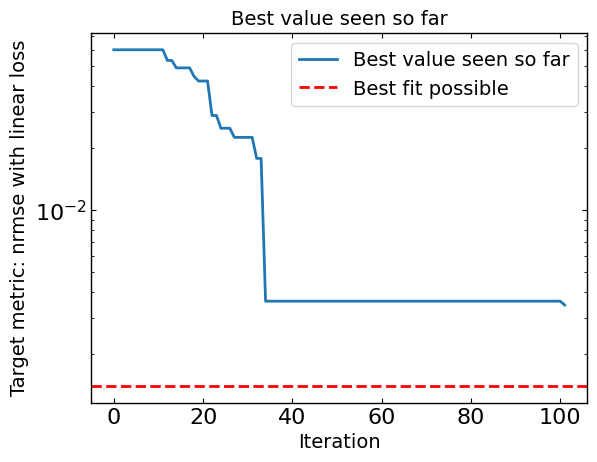
# Plot optimization results
data = ax_client.summarize()
all_metrics = optimizer.all_metrics
plt.figure()
plt.plot(np.minimum.accumulate(data[all_metrics]), label="Best value seen so far")
plt.axhline(y=best_fit_possible, color='red', linestyle='--', label="Best fit possible")
plt.yscale("log")
plt.xlabel("Iteration")
plt.ylabel("Target metric: " + metric + " with " + loss + " loss")
plt.legend()
plt.title("Best value seen so far")

print("Best value seen so far is ", min(data[all_metrics]), "at iteration ", int(data[all_metrics].idxmin()))
print("Best value possible is ", best_fit_possible)
plt.show()
Best value seen so far is  JV_JV_nrmse_linear at iteration  99
Best value possible is  0.0015363848442940548
[9]:
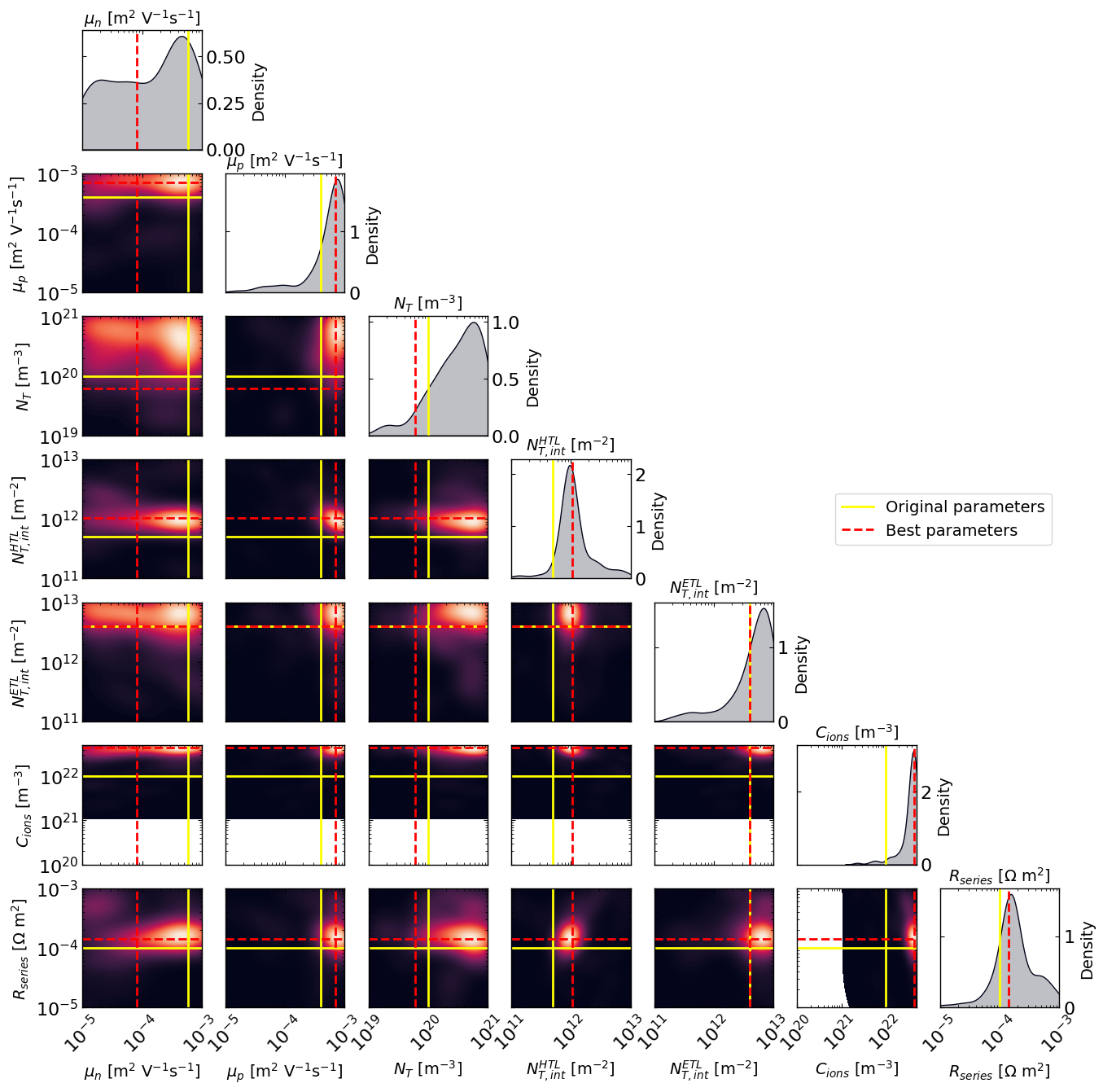
# Plot the density of the exploration of the parameters
# this gives a nice visualization of where the optimizer focused its exploration and may show some correlation between the parameters
plot_dens = True
if plot_dens:
    from optimpv.posterior.exploration_density import *
    params_orig_dict, best_parameters = {}, {}
    for p in params_orig:
        params_orig_dict[p.name] = p.value
    for p in optimizer.params:
        best_parameters[p.name] = p.value

    fig_dens, ax_dens = plot_density_exploration(params, optimizer = optimizer, best_parameters = best_parameters, params_orig = params_orig_dict, optimizer_type = 'ax')
[10]:
# rerun the simulation with the best parameters
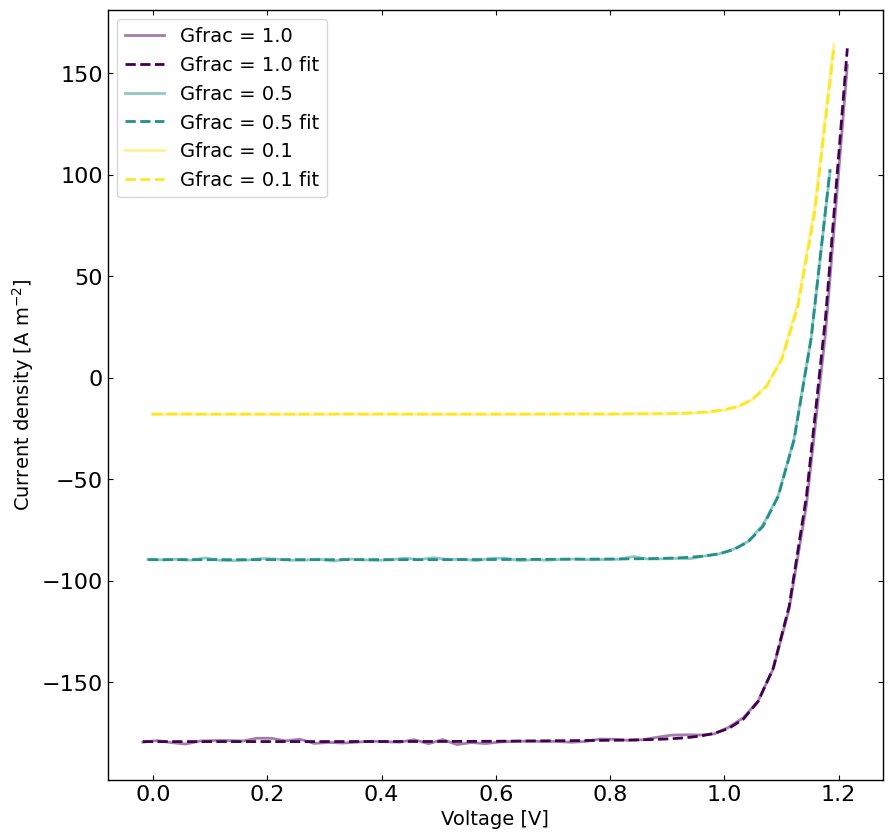
yfit = jv.run(parameters={}) # run the simulation with the best parameters

viridis = plt.get_cmap('viridis', len(Gfracs))
plt.figure(figsize=(10,10))
linewidth = 2
for idx, Gfrac in enumerate(Gfracs[::-1]):
    plt.plot(X[X[:,1]==Gfrac,0],y[X[:,1]==Gfrac],label='Gfrac = '+str(Gfrac),color=viridis(idx),alpha=0.5,linewidth=linewidth)
    plt.plot(X[X[:,1]==Gfrac,0],yfit[X[:,1]==Gfrac],label='Gfrac = '+str(Gfrac)+' fit',linestyle='--',color=viridis(idx),linewidth=linewidth)
plt.xlabel('Voltage [V]')
plt.ylabel('Current density [A m$^{-2}$]')
plt.legend()
plt.show()
[11]:
# Clean up the output files (comment out if you want to keep the output files)
sim.clean_all_output(session_path)
sim.delete_folders('tmp',session_path)
# uncomment the following lines to delete specific files
sim.clean_up_output('PTAA',session_path)
sim.clean_up_output('fakePerovskite',session_path)
sim.clean_up_output('C60',session_path)
sim.clean_up_output('simulation_setup_fakePerovskite',session_path)
for file in optical_files:
    sim.clean_up_output(file,session_path)